printlogo
http://www.ethz.ch/index_EN
Welcome
 
print
  
English Deutsch

Quantum Optoelectronics group (Prof. J.Faist)

Quantum Optoelectronics Group

This laboratory is dedicated to the manufacture and study of large quantum systems (also called mesoscopic systems). By nature, these systems are at the frontier between classical and quantum mechanics. Researchers are entering the mesoscopic world when trying for example to miniaturize transistors inside computer chips or to control DNA.

Mesoscopic systems also open new functionalities impossible to obtain from purely classical objects: researchers around the world are trying to construct a quantum computer which could in principle solve mathematically hard problems (like the factorization of large numbers) that classical computers could not tackle.

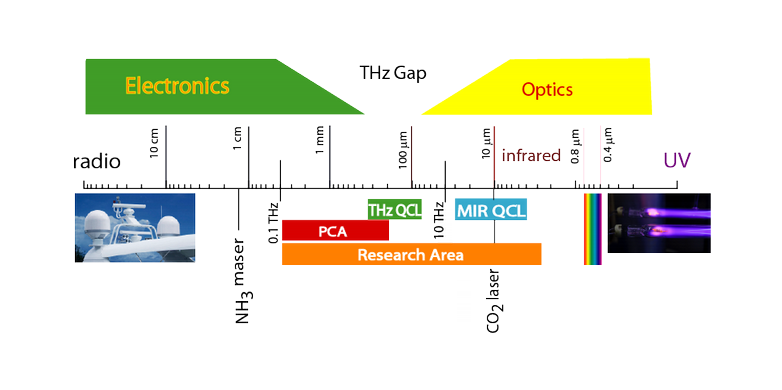
The present work of the laboratory is dedicated to the study of structures like the quantum cascade laser. The Quantum Cascade Laser (QCL) is a semiconductor laser involving only one type of carriers and which is based on two fundamental phenomena of quantum mechanics, namely tunneling and quantum confinement. It is fabricated by a technique called Molecular Beam Epitaxy in which the layers are "sprayed" one layer at the time.

QOE group members / Gruppenmitglieder

News

Original QCL-patent nominated for European Inventor Award

07.05.2012. The European Patent Office annually awards the European Inventor Award, honouring outstanding inventours and entrepreneurs. The original QCL patent, based on work of Prof. Jérôme Faist, Prof. Federico Capasso (Harvard University) and coworkers in Bell Labs is among the nominees. The nomination is based on the groundbraking advancements achieved through QCLs which are able to reach areas of the electromagnetic spectrum previously untouched by laser light. Today, the ability of QCLs to produce wide bandwidths, high brightness, and high power very efficiently from a compact source has resulted in an array of unique products, from hand-held sensors for explosives detection and other toxic chemicals, to more powerful radar systems.

Faist group research highlighted in Semiconductor Science and Technology

03.05.2012. Our recent work on short wavelength Sb-free Quantum Cascade Lasers has been highlighted by Semiconductor Science and Technology. The covered spectral region of 3-4µm is very interesting for e.g. sensing applications. Avoidance of Sb is key for growth and fabrication of lasers. Read more in our research section.

Short wavelength QCL highlighted

16.03.2012. Semiconductor Today highlighted our demonstration of a 3.3µm Sb-free Quantum Cascade Laser in http://www.semiconductor-today.com/news_items/2012/MAR/ETH_150312.html

Faist group results on the ultra strong coupling regime published in Science

15.03.2012. In the so called ultra strong coupling regime, the coupling strength of an electron excitation to a photonic mode can become very large and even comparable to the individual excitation energies. A range of new phenomena is predicted in this regime.
We could demonstrate the to date strongest light matter interaction, by coupling a cyclotron transition of a 2D electron gas to a cavity.
These results are published in Science 335, pp. 1323-1326.

Group Skiing trip!

13.03.2012. The Faist Group skiing trip led us to the beautiful "Lenzerheide" resort on this Tuesday. Weather and snow conditions were great. Find a picture of Prof. Faist giving a "ski lesson" on the right.

Faist group work is featured in Phys. Rev. Lett.

10.03.2012. Recent work on the ultra strong coupling regime, which can be achieved when coupling parabolic quantum wells to a single mode microcavity is published in Phy. Rev Lett. 108 , 106402.
By using a pseudoharmonic potential, we are able to observe the full coupling strength (Rabi frequency is 27% of the intersubband transition frequency) from cryogenic up to room temperature. In this structure, a depolarization shift is exactly compensated, which is in agreement wich Kohn's theorem. For these reasons, parabolic quantum wells as a very attractive system to study the ultra strong coupling regime.

Graduate receives ETH medal

13.01.2012. Christoph Walther, a recent graduate of the Faist group received the ETH medal in recognition of his extraordinary results. His focus was on low frequency and circuit based Quantum Cascade Lasers. Congratulations!

Faist group graduate honoured with Swiss Physical Society Award

17.06.2011. Maria Amanti receives the 2011 Swiss Physical Society Award for Applied Physics. Quoting from the laudatio: "Maria has developed as her PhD work a novel approach for cavities of terahertz quantum cascade lasers to overcome processing and conceptual difficulties: By using a dry etching technique, she achieved the fabrication of high aspect ratio ridge structures with a lateral distributed feedback operating as a third order grating which provides at the same time the feedback for the laser mode and the outcoupling to the free space. In this way, a single mode operation was achieved at a frequency defined by the grating periodicity.. Congratulations!


Wichtiger Hinweis:
Diese Website wird in älteren Versionen von Netscape ohne graphische Elemente dargestellt. Die Funktionalität der Website ist aber trotzdem gewährleistet. Wenn Sie diese Website regelmässig benutzen, empfehlen wir Ihnen, auf Ihrem Computer einen aktuellen Browser zu installieren. Weitere Informationen finden Sie auf
folgender Seite.

Important Note:
The content in this site is accessible to any browser or Internet device, however, some graphics will display correctly only in the newer versions of Netscape. To get the most out of our site we suggest you upgrade to a newer browser.
More information

© 2012 ETH Zurich | Imprint | Disclaimer | 12 May 2012
top